Take the first step towards a global career
Take the first step towards a global career
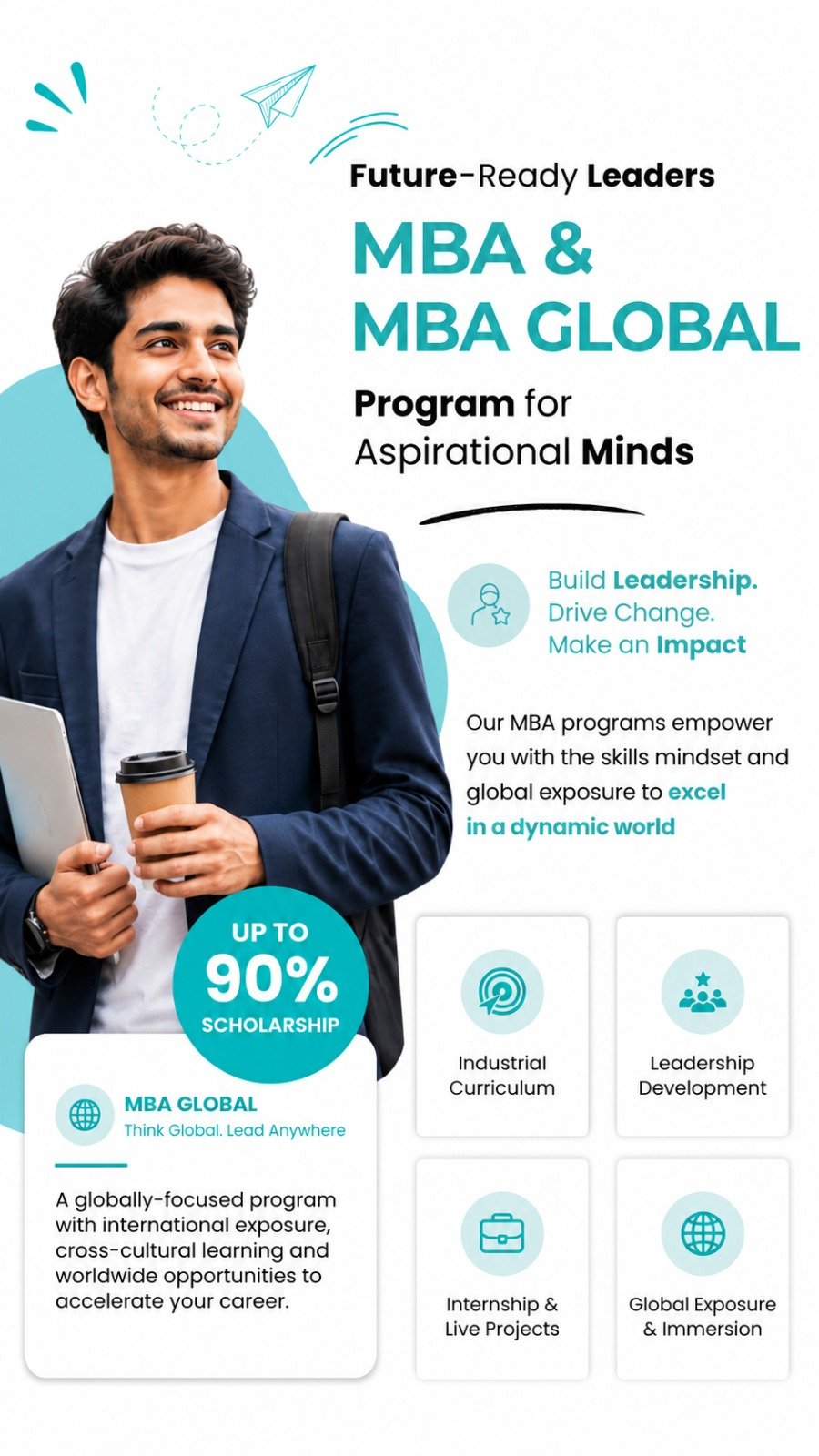
An MBA (Master of Business Administration) is one of the most sought-after postgraduate management programs, designed to prepare students for leadership roles across industries. The program combines core business knowledge with practical learning, strategic thinking, and industry-oriented skills to help students excel in today’s competitive business environment.
Modern MBA programs go beyond traditional classroom education by integrating technology, real-world business challenges, data-driven decision-making, and industry exposure. Students gain a strong foundation in management while developing specialized expertise in areas aligned with their career goals.
| MBA Program Features | Benefits & Career Advantages |
|---|---|
|
Industry-Oriented Curriculum |
Learn through case studies, live projects, internships, and business simulations that prepare you for real-world management challenges. |
|
Multiple MBA Specializations |
Choose from Finance, Marketing, HR, Business Analytics, Operations, International Business, Digital Marketing, Healthcare, and more. |
|
Business Analytics & AI Learning |
Develop practical skills in AI, Power BI, Business Analytics, Data Visualization, ERP, and digital business tools for modern management roles. |
|
Leadership & Management Skills |
Strengthen communication, strategic thinking, leadership, problem-solving, negotiation, and decision-making abilities. |
|
Corporate Exposure |
Gain valuable industry experience through internships, guest lectures, consulting projects, industrial visits, and corporate interactions. |
|
Placement & Career Opportunities |
Explore career opportunities in Banking, Consulting, IT, FMCG, Healthcare, Manufacturing, Retail, E-commerce, and Startups. |
|
Top Recruiters |
MBA graduates are hired by leading companies including Deloitte, EY, KPMG, Accenture, Amazon, Google, TCS, Infosys, HDFC Bank, and many more.
|
|
MBA with SAP & SAS |
Students targeting analytics, business systems, consulting, and data-driven managerial roles |
(Common Admission Test)
( Management Aptitude Test)
(NMIMS Management Aptitude Test)
UPES Management Aptitude Test)
| Scholarship Term | Discount | Which For |
|---|---|---|
|
12TH |
20% -Up To 90% |
Depends On Marks/Score |
|
CAT |
20% -Up To 90% |
Depends On Marks/Score |
|
XAT |
20% – Upto 90% |
Depends On Marks/Score |
|
MAT |
20% -Upto 90% |
Depends On Marks/Score |
|
CMAT |
20% – Up to 90% |
Depends On Marks/Score |
|
Uttarakhand Domicile |
10% -Up To 25% |
Only For Uttarakhand Students |
|
Ward Of Single Mother |
5% – Upto 10% |
Ward of Single Mother |
|
Defence Personal |
5% – Up To 10% |
Depends On Marks/Score |
|
Sports Quota |
Up To 50% |
Depends On Marks/Score |
|
Satya Scholarship |
Upto 25% |
Only For DRCC Students |
Master data analysis, business intelligence, predictive analytics, AI, and data-driven decision-making to solve modern business challenges.
Learn digital business strategies, cloud technologies, AI, automation, innovation management, and digital leadership for the future economy
Build expertise in brand management, digital marketing, consumer behaviour, advertising, sales strategy, and market research.
Develop leadership, talent acquisition, employee engagement, performance management, labour laws, and organizational development skills.
Gain knowledge in financial management, investment analysis, banking, taxation, corporate finance, fintech, and risk management.
Understand global markets, international trade, export-import management, cross-cultural communication, and global business strategy.
Learn procurement, inventory management, warehouse operations, logistics planning, transportation, and supply chain optimization.

Partner colleges offer excellent placement opportunities through internships, industry collaborations, live projects, and campus recruitment from leading companies.
Yes. An MBA continues to be one of the most valuable postgraduate degrees due to increasing demand for skilled business professionals across industries. With rapid growth in digital transformation, artificial intelligence, fintech, e-commerce, consulting, healthcare, and global business, organizations require managers who can combine business strategy with technology and innovation. An MBA equips students with leadership, analytical, and decision-making skills, making it an excellent investment for long-term career growth and global opportunities.
To apply for an MBA program in India, candidates must have completed a bachelor’s degree in any discipline from a recognized university with the minimum qualifying marks required by the respective institution. Final-year undergraduate students can also apply in many colleges. Admission may be based on entrance exam scores, merit, or a combination of group discussion (GD) and personal interview (PI), depending on the college or university.
The salary depends on the candidate’s skills, specialization, internship experience, and recruiting company.
Typical salary ranges are:
Students with expertise in AI, Data Science, Cloud Computing, Cyber Security, and Full Stack Development often receive higher salary packages.
An MBA opens doors to a wide range of career opportunities in both private and public sectors. Graduates can work as Business Analysts, Marketing Managers, Financial Analysts, HR Managers, Operations Managers, Project Managers, Product Managers, Investment Bankers, Consultants, Digital Marketing Managers, Supply Chain Managers, Business Development Managers, and Entrepreneurs. MBA graduates are recruited by multinational corporations, startups, consulting firms, financial institutions, and leading global organizations.
The most popular MBA entrance exams accepted by leading colleges and universities include CAT, XAT, MAT, CMAT, NMAT, SNAP, ATMA, IBSAT, CUET PG, MAH MBA CET, TANCET MBA, KMAT, Karnataka PGCET, and several university-specific entrance exams. Different institutions accept different exams, so students should check the admission requirements before applying.